A hyperlocal forecast and a verdict on whether to go to the beach, hike the mountain, or stay in for wine. Built by Capetonians.
Real conditions, plain language. Updated every hour from local stations.
Warm, calm — classic beach day.
Crisp visibility — go now.
Workable conditions.
Light wind. Check Blouberg later.
Perfect day in Stellenbosch.
Running. Go early.
Cape Town has a dozen distinct microclimates. Camps Bay can be still while Bloubergstrand is howling. Pick your spot.
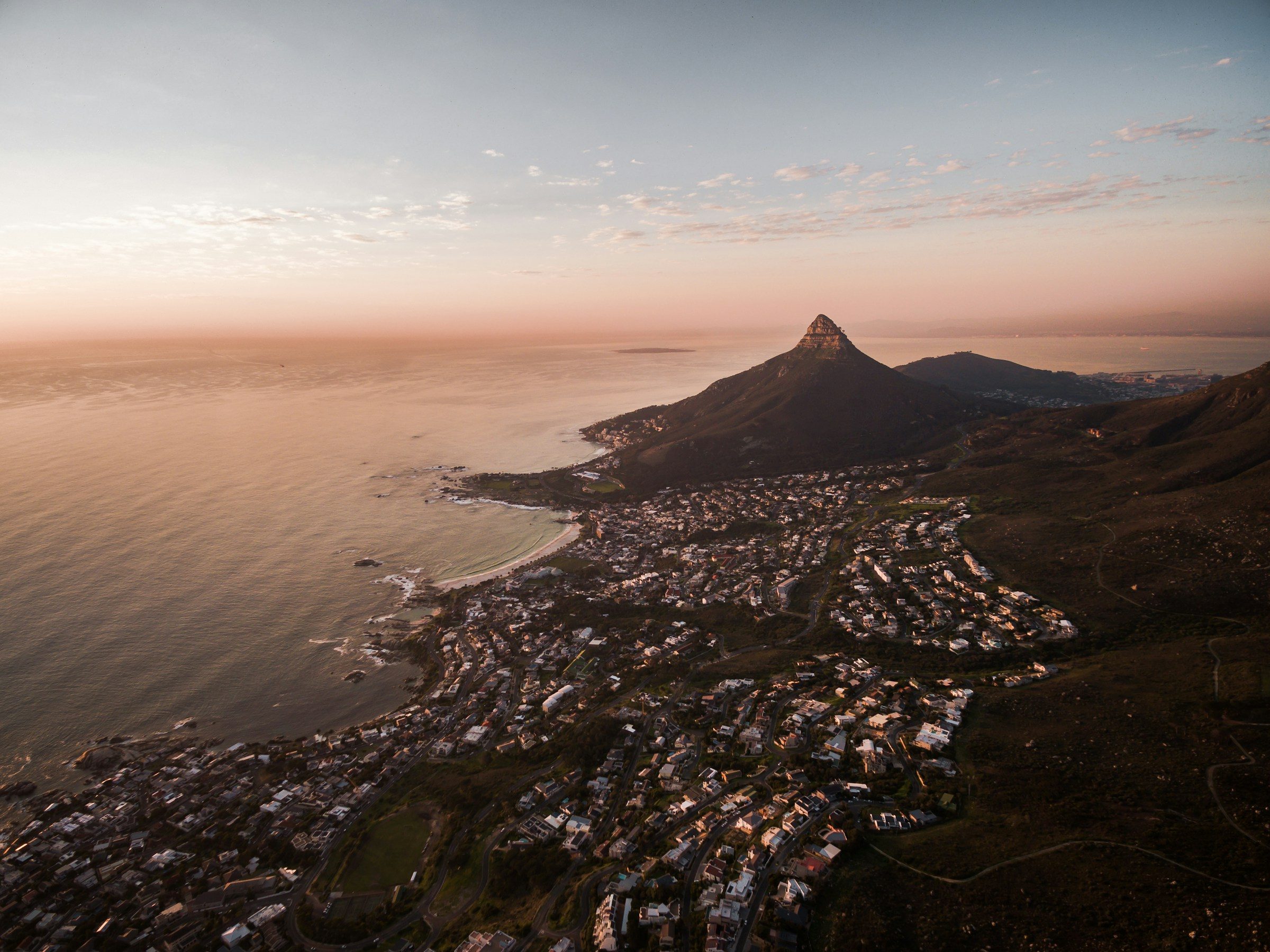
Sheltered from the South Easter by Lion's Head. Often calm when the rest of the city is howling.
Atlantic SeaboardThe promenade is a year-round measure of the city's mood. Wind exposure is moderate.
City BowlThe most visited spot in Africa. Generally mild, with the harbour offering shelter from the worst wind.
False BayWarmer water, gentler waves, the city's classic learn-to-surf beach. Different weather pattern entirely.
West CoastThe wind that ruins your beach day is the wind that makes Big Bay a world kitesurfing destination.
WinelandsAn hour inland and a different climate entirely. Hotter summers, frost in winter, and the Cape's most distinctive wine valley.
West CoastThe lagoon escape 90 minutes north. Warmer water, more reliable wind, often delivering exactly what Cape Town isn't.
PlanningMonth-by-month climate guide for choosing when to come. Honest pros and cons.
Apple Weather can tell you Cape Town will be 23°C with 25 km/h wind. That's true and almost useless. The same conditions are a perfect day at Constantia and an unswimmable mess at Camps Bay. The same wind that closes the Table Mountain cable car is what kitesurfers drive across the country to find.
weather.capetown is built by people who actually live here. We translate raw data into the only thing that matters: what should you do today, and where should you do it?
You'll get a real answer for the V&A Waterfront, for Camps Bay, for Muizenberg, for Bloubergstrand, for the Winelands. Plus tide times, sunrise data, fire warnings in summer, and honest verdicts on whether the conditions match your plans. No 14-day forecast nonsense, no buried ads, no signing up for anything.
Bookmark it. We update every hour.
If you've never spent a summer in Cape Town, the local relationship with weather can be confusing. We are not a tropical city. We are not a temperate city in the European sense either. We have a Mediterranean climate — winter rain, summer drought — which is unusual for southern Africa and creates a set of conditions that no generic forecast captures. The short version: the city has two completely opposite seasons separated by short shoulder windows, two oceans of different temperatures touching opposite coasts of the same peninsula, and a wind that is so distinctive and so culturally significant that it has its own name and folklore (the Cape Doctor).
Hot, dry, very windy, very long days. Daytime temperatures average 26–28°C in the City Bowl and on the Atlantic seaboard, often hitting 32–35°C in the Winelands and on the Cape Flats. Rainfall is essentially zero from December to February. The South-Easter wind blows on most afternoons from late October to early April, with peak intensity in January. Daylight runs from sunrise around 05:30 to sunset around 19:55 at the summer solstice. UV is extreme (10–12 at midday) — non-trivial sun protection is a daily requirement.
Cape Town's best-kept secret. The wind drops away. The temperature stays warm (22–26°C). The first rains arrive but only as the occasional shower. Skies are softer, light is golden, the city feels exhaled after the summer rush. Hotel prices halve. Locally regarded as the year's prime stretch.
Mild Mediterranean winter. Daytime temperatures 14–18°C; nights 7–11°C; very occasional 5°C cold mornings during cold-front passages. Rainfall concentrated in this season — 70–100 mm per month — usually as week-long systems of frontal weather followed by clear, calm, beautiful days in between. The North-Wester wind replaces the South-Easter and brings most of the year's rain. Snow on the surrounding mountains (Ceres, the Hex River) is common. The Winelands at their most atmospheric.
Variable but often spectacular. The first wildflower bloom of the West Coast happens in August and September — fields of orange, white and yellow stretching to the horizon at Postberg, Darling and the Cederberg. Temperatures climb gradually, the rain tapers, the wind starts to come back. Whales (southern right and humpback) are at the peninsula coast from June through November, peaking in September. Many Capetonians consider spring their second-favourite season after autumn.
The Cape Peninsula is touched by two oceans that don't quite agree. The Atlantic on the west is cold all year (12–18°C, occasionally dipping into single digits on upwelling days). The False Bay coast on the east — only thirty kilometres away as the gull flies — is significantly warmer (16–22°C in summer). The reason is current geography: the cold Benguela Current sweeps up the west coast from the Antarctic, while False Bay is influenced by warmer Agulhas-derived water. The practical consequence: the same day's swim in Cape Town can be a teeth-chattering one-minute dip at Camps Bay or a comfortable forty-minute float at Muizenberg, depending on which side of the mountain you're on.
The South-Easter, locally and historically called the Cape Doctor, is the single most important weather variable for daily decision-making in Cape Town in summer. It is not a passing front, it is not a storm — it is a thermal wind that builds reliably most afternoons in November through March in response to the temperature difference between cold Atlantic water and the hot interior. On a typical summer afternoon you'll see sustained 25–45 km/h wind on the most exposed coasts and 10–20 km/h in the city centre. On the strongest days, sustained 60 km/h gusting 80 km/h. The Cable Car closes; the open-air restaurants pivot indoors; umbrellas blow inside-out; the city's outdoor life pauses until 18:30 when the wind usually relaxes.
The wind is also a gift. It clears air pollution (the "doctor" part of the nickname comes from a historical belief that the wind cleared diseases from the city, which was wrong but understandable). It cools the city through the worst of the heat. It is the entire reason Cape Town is one of the world's premier kitesurfing destinations. Local culture has adapted around it; locals plan beach time before 11:00 and dinner indoors. Visitors who treat the wind as an inconvenience tend to have a worse time than visitors who treat it as a daily variable to plan around.
Because Table Mountain rises 1,000 m directly out of the city centre and the peninsula stretches 50 km south between two oceans, Cape Town has — depending on how you count — somewhere between eight and twelve distinct microclimates. A summer afternoon can simultaneously deliver a 24°C calm beach day at Camps Bay (sheltered by Lion's Head), a 22°C 35-km/h sand-blasted afternoon at Sea Point (no shelter), a 26°C calm 19°C-water day at Muizenberg (on the other side of the mountains, in False Bay), a 21°C 30-knot kite session at Big Bay (in the West Coast wind tunnel), and a 32°C calm 35°C-vineyard afternoon at Stellenbosch (inland, beyond the mountains). All of those readings can be valid at the same hour. This is why our pages are organised by neighbourhood, not by city — and why the homepage gives you a starting verdict but the real planning happens on the location-specific pages.
We cover the Cape Peninsula and its immediate hinterland: the Atlantic seaboard (Sea Point, Camps Bay, Clifton, Bantry Bay, Bakoven, Llandudno, Hout Bay), the City Bowl and the V&A (V&A Waterfront, the city centre, Tamboerskloof, Oranjezicht), False Bay (Muizenberg, Fish Hoek, Simon's Town, Kalk Bay), the West Coast (Bloubergstrand, Sunset Beach, Melkbosstrand, Langebaan), and the Winelands (Paarl, Stellenbosch, Franschhoek, Constantia). We cover the activities that depend on conditions: surf, kitesurf, hiking, wine tasting, swimming, sailing, cycling. We cover the weather phenomena that shape the city: the Cape Doctor, the tablecloth cloud, cold fronts, Berg winds, bluebottle invasions, fire risk and the seasons. New coverage is added based on reader request — see our contact page.
Cape Town's weather varies dramatically by neighbourhood due to its mountain-and-ocean geography. The Atlantic seaboard (Camps Bay, Sea Point) typically runs 2–3°C cooler than False Bay (Muizenberg, Simon's Town). The South Easter wind, locally called the Cape Doctor, often blows in summer afternoons.
The shoulder seasons — late October to early December, and February to April — offer the best balance of warm weather, lower wind, fewer crowds, and reasonable prices. Peak summer (December–January) is hot and very busy. Winter (June–August) brings rain and cold but dramatic weather and significantly lower prices.
The South Easter — locally called the Cape Doctor — is caused by a high-pressure system over the South Atlantic interacting with low pressure over the interior. Table Mountain channels and accelerates the airflow, particularly in summer.
It depends entirely on which side of the peninsula you're on. The Atlantic seaboard sits at 12–17°C year-round (cold even in summer due to the Benguela Current). False Bay water runs 16–22°C and is significantly more swimmable, especially in late summer.
Cape Town has a mild Mediterranean winter — daytime temperatures typically 14–18°C, nights 7–10°C. It rarely freezes. The defining feature of winter is rain (concentrated June–August) and occasional dramatic cold fronts.
Tomorrow's verdict, the weekend outlook, one local recommendation. No spam. Free.