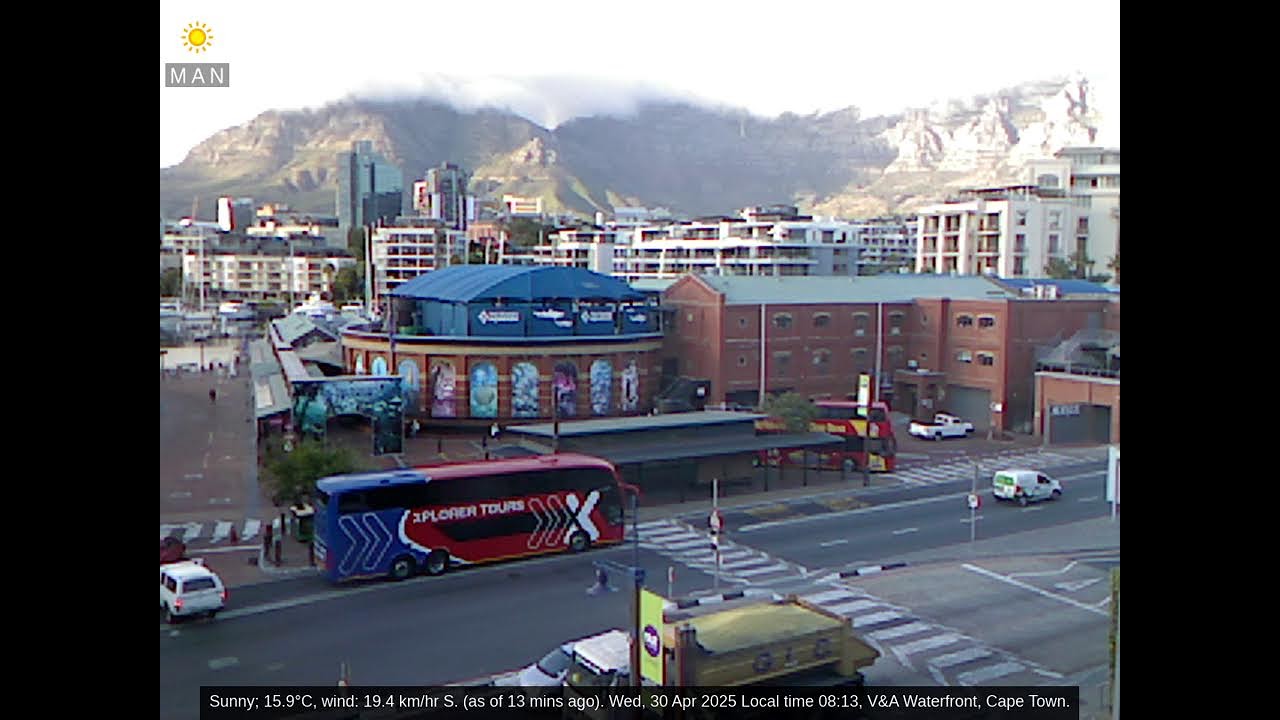
In short
The V&A Waterfront is sheltered from most Cape Town wind by Signal Hill and the harbour walls. Temperatures are typically mild — within 1–2°C of the broader city. The classic Table Mountain view is best in morning light. Expect crowds in summer; arrive early or after 16:00 for a less crushing experience. The Two Oceans Aquarium and the indoor V&A complex are excellent rainy-day options.
The harbour microclimate
The V&A Waterfront occupies the original harbour basins of Cape Town, dating to the 1860s. The harbour walls, breakwaters and the bulk of Signal Hill behind create a partially-protected pocket where wind speeds typically run 10–20% below those at the more exposed Sea Point or Three Anchor Bay. On a 35 km/h South Easter day, the V&A might see 25 km/h — still windy but no longer punishing.
Temperature-wise the V&A sits in the same band as the broader City Bowl: warmer than Camps Bay, cooler than the Cape Flats, generally 1–3°C below the Winelands inland. Humidity off the harbour can feel sticky on calm summer afternoons, but the constant air movement from Table Bay usually keeps things comfortable.
Reading Table Mountain from the V&A
The V&A is the postcard view of Table Mountain — and a working weather instrument if you know how to read it. Three things to watch:
- The tablecloth — that distinctive flat layer of cloud spilling over the mountain top — is caused by moist air being pushed up the south face by the South Easter, condensing into cloud, then rolling down the north face and dissipating. It tells you the wind is up. A thick tablecloth means strong wind. A thin one usually means moderate wind. No tablecloth in summer often means light wind, which is rare and lovely.
- Cloud on the cable car upper station means the cable car will likely be closed. The operators rarely run the lower stations into thick cloud. Save yourself the drive up.
- Lenticular clouds (smooth lens-shaped clouds) hovering above or downwind of the mountain are a strong indicator of an approaching weather change — usually a North Wester within 24 hours.
The cable car question
Plenty of visitors arrive in Cape Town with "Table Mountain by cable car" as the first item on their list, and discover it's closed for high wind. The cable car has wind-speed safety thresholds and it doesn't run when the upper station's wind exceeds them — which can be most afternoons in summer.
The practical advice: book the cable car for early morning in summer (before 11:00). The South Easter usually picks up between 11:00 and 14:00. In winter, the cable car is more often closed for cloud and rain. Always check the live status before driving up — see the official cable car status page or our weather verdicts on the homepage.
What to do in different conditions
- Calm and sunny: Walk the entire waterfront, do the Aquarium if you have kids, climb the Clock Tower, and get a Robben Island ferry (winds and seas need to be moderate for the boat to run).
- Windy but sunny: Stay in the central V&A — most attractions are indoor or covered. The V&A Food Market and the Watershed (craft and design hall) are wind-immune.
- Raining: The Two Oceans Aquarium is one of the best rainy-day spots in Cape Town. The Zeitz Mocaa contemporary art museum is just nearby. Indoor shopping and dining keeps you busy for a full day.
- Cold front: Watch the swell crash against the breakwater near the lighthouse — properly dramatic. Then retreat to the Time Out Market or one of the harbour-side restaurants.
A short history of the harbour
The V&A Waterfront sits in the original commercial harbour of Cape Town, built in the 1860s during the colonial expansion of the Cape Colony. The two main basins — the Alfred Basin (1870) and the Victoria Basin (1905) — are named for Queen Victoria's second son and for the queen herself. For a century the harbour was a working dock for cargo and fishing; ships unloaded grain, wool, fruit and ivory, and Cape Town was a critical stop for steamers between Europe and the East. Containerisation in the 1970s moved heavy cargo to a new port at the Duncan Dock to the east, leaving the original basins underused.
Redevelopment of the harbour into a mixed-use waterfront began in 1988. Today the V&A is a 123-hectare district housing over 450 retailers, 80 restaurants, a working fishing fleet, a residential community, two museums of international rank, and the most-visited tourist destination on the African continent — around 24 million visits a year, pre-pandemic and rebuilding fast. Through all of this, the harbour kept functioning: the tugboats still leave from the basin daily, and on some mornings you'll see seals fighting over discarded fish heads off the slipway.
The sub-areas of the V&A
The Waterfront is large and locals use different names for its parts.
- The Pierhead — the central retail core around the Amphitheatre and the Two Oceans Aquarium. The most photographed area.
- The Clock Tower precinct — across the swing bridge, anchored by the red-and-white 1882 Clock Tower (originally the port captain's office). Less crowded; departure point for Robben Island ferries.
- The Silo District — the converted grain silo complex housing the Zeitz Museum of Contemporary Art Africa (Zeitz MOCAA) and the Silo Hotel. The interior of the museum, with its carved-out concrete chambers, is one of the most arresting public spaces in southern Africa.
- The Watershed — a large warehouse turned into a craft and design hall. Local artisan products; great rainy-day browsing.
- Battery Park — newer development to the east, including the Time Out Market food hall and offices.
- The Granger Bay marina — yacht moorings and the working boat slipways. Quieter, with restaurants like the Boatshed café and the Polana.
The Two Oceans Aquarium
One of the southern hemisphere's best aquaria, with thirty exhibits showcasing the wildlife of the cold Atlantic and warmer Indian Ocean that meet near Cape Point. The kelp forest exhibit is the signature display — a four-storey tank with swirling shoals and the occasional ragged-tooth shark. The penguin exhibit, the seahorses, and the I&J Predator Tank are reliable crowd-pleasers. Entry is around R270 for adults (less for residents and children). Allow at least two hours; on rainy days, allow three and have lunch at the cafeteria.
Seals, dolphins and what's in the harbour water
The V&A harbour basins are home to a permanent colony of Cape fur seals, which haul out on the wooden jetties around the slipways and entertain visitors year-round. The harbour also sees occasional dolphin pods entering the basin during summer; the rare humpback or southern right whale appears in Table Bay from June to November. The water itself is not swimmable — it's a working harbour with oil, fuel and waste — but local kayak tours operate from the Clock Tower marina and offer a close-up view of the seals and the basin geometry from sea level.
Sunset and golden-hour photography
Common wisdom says sunset doesn't work from the V&A because the sun is behind the harbour, not over it. That's true for the classic mountain shot — which is best in morning light when Table Mountain catches the eastern sun — but the V&A has its own sunset opportunities:
- The swing bridge at golden hour: the warm light on the red Clock Tower reflects beautifully in the Alfred Basin.
- Silo District rooftop bars: several restaurants in the Silo Hotel and the Watershed have rooftop terraces with a mountain-and-harbour view that catches sunset light.
- Granger Bay walk: step ten minutes west and the angle opens up; you can shoot the harbour mouth with Lion's Head behind, lit by setting sun.
For mountain-with-sunset, the V&A team's recommended move is to grab a sundowner at the Marine Wharf or the Promenade, then walk five minutes to the Granger Bay edge for the actual sunset moment. The mountain glows pink for ten minutes; you'll see local photographers lined up with tripods.
Robben Island and the ferry
Robben Island, the prison island where Nelson Mandela spent 18 of his 27 years of imprisonment, sits 7 kilometres offshore in Table Bay. The official Robben Island Museum operates several daily ferries from the Nelson Mandela Gateway at the Clock Tower precinct. The full tour is around 3.5 hours (boat both ways, bus tour of the island, prison tour led by a former political prisoner) and costs about R600 for adults.
The boats are weather-dependent. Sustained 35 km/h+ wind or a sea state above 2 m typically cancels departures. South Easter days cancel more boats than rain — paradoxically the calmest crossings are often on cloudy cold-front days when the wind has dropped to chase the front. Book at least 48 hours ahead, ideally a week in summer, and have a Plan B (the District Six Museum, the Castle, the Slave Lodge) ready for the day if you're cancelled.
The cable car question, in more detail
Plenty of visitors arrive in Cape Town with "Table Mountain by cable car" as the first item on their list, and discover it's closed for high wind. The cable car has wind-speed safety thresholds — usually around 50 km/h sustained or 70 km/h gusts at the upper station — and it doesn't run when those are exceeded, which can be most afternoons in summer.
The practical advice: book the cable car for early morning in summer (before 11:00). The South Easter usually picks up between 11:00 and 14:00. In winter, the cable car is more often closed for cloud and rain than for wind, and the chances of being trapped at the top in cloud are real. Always check the live status (the official cable car app updates conditions every 15 minutes) before driving up. From the V&A, the cable car lower station is a 15-minute drive via Kloof Nek Road.
Practical notes
- Parking: Multiple paid parking garages, around R10–R15/half-hour. The Clock Tower side and Silo District are usually less crowded than the central V&A garage. Saturdays in peak summer can mean a 20-minute search for a bay.
- MyCiti bus: Direct route from the city centre and Sea Point. Drops you at the V&A entrance. R12–R20 fare depending on distance.
- Robben Island ferry: Book at least 48 hours ahead. Departures are weather-dependent — strong wind cancels boats more often than rain.
- Best photo time for the mountain: 06:30–08:30 in summer, slightly later in winter. The mountain catches the eastern sun and is reliably free of tablecloth before the wind builds.
- Indoor options for bad weather: Two Oceans Aquarium, Zeitz MOCAA, the Watershed, the V&A Food Market, the Time Out Market at Battery Park.
- Free things to do: Watching the seals; the swing bridge crossings; the buskers at the Amphitheatre (afternoons); browsing the Watershed without buying.
- Sunset and after dark: The V&A stays busy until 22:00 in summer. The Time Out Market and many of the restaurants run later. Security is high; this is one of the safest precincts in the city after dark.